


You helped change voting accessibility. Thank you!

Jun 8
3 min read
Two years ago, members of the Clinically Vulnerable community began telling us something was wrong. People who had voted all their lives no longer felt able to vote in person. The introduction of voter ID had created a new barrier. For Clinically Vulnerable voters and others who continued to wear a mask indoors being asked to remove it, even briefly, made attending a polling station less safe.
Many of you shared your experiences with us. You completed surveys. You told us what happened at polling stations. You explained the practical realities of trying to participate in democracy while managing health risks.
Most importantly, you trusted us with your stories. So today, we want to say thank you!
Your voices led to change
Following engagement from CVF and others, the Electoral Commission updated its guidance ahead of the 2026 elections.
For the first time, the guidance explicitly recognised Clinically Vulnerable voters and described adjustments that could help make voting more accessible, including outdoor ID checks and other practical measures.
Clinically Vulnerable people and those in Clinically Vulnerable families often tell us that their needs have been invisible within public policy. Seeing our needs acknowledged in national electoral guidance was an important step forward.
Seeing our needs acknowledged in national electoral guidance was an important step forward. It demonstrates that when an independent regulator recognises an overlooked group and designs practical solutions, real change happens - and it sets a precedent for other policy areas watching how accessibility can and should work.
Did the changes make a difference?
Our recent 'Voting Accessibility Audit 2026' suggests they did. However, our most important finding is about participation.
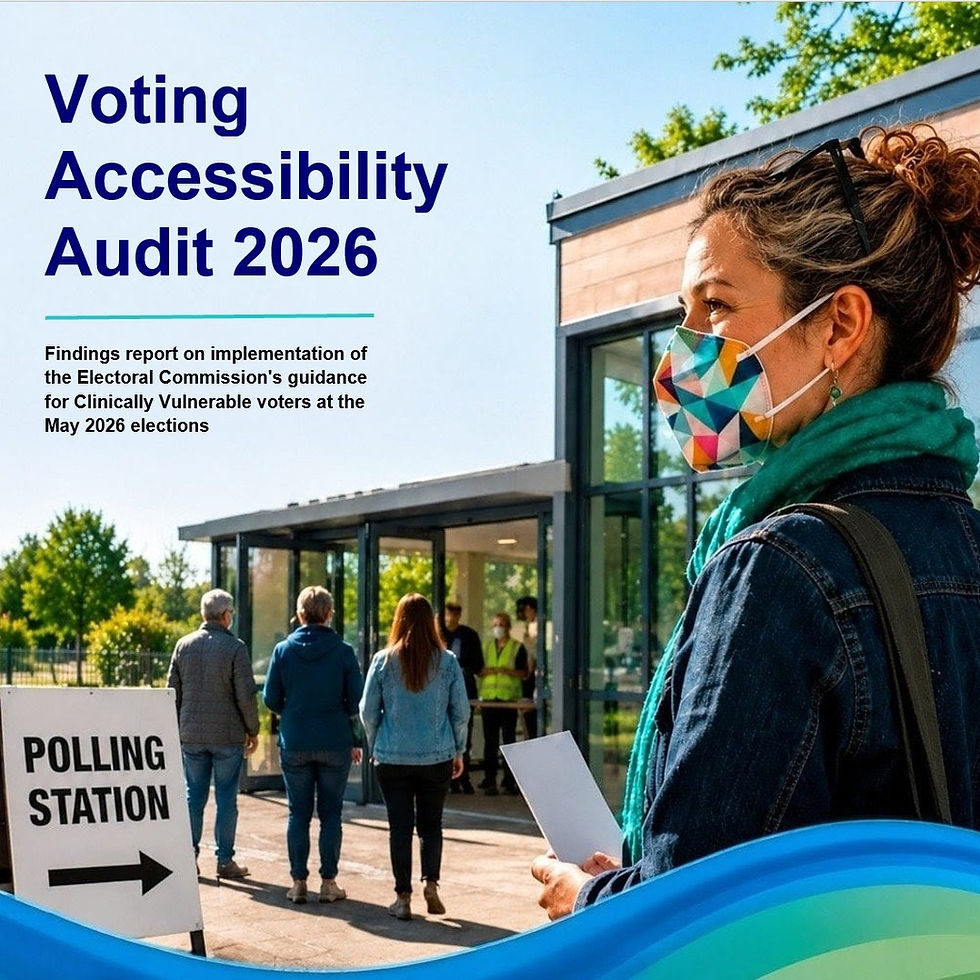
Around a third of respondents told us that the changes enabled them to return to voting in person for the first time
since voter ID was introduced.
We are pleased that because these mew barriers were identified and addressed, safer in person participation is now increasing.
There is still more to do
The audit also found that implementation remains inconsistent when it comes to voting accessibility. While some polling stations embraced the guidance, others appeared unaware of it. Also many respondents only learned about the available adjustments through CVF rather than through official election communications.
It is important to recognise that this does not mean the guidance has failed. If anything, our findings suggest the opposite. The guidance appears capable of improving accessibility when it is understood and applied.
The next challenge is to ensure that voters know about it, staff understand it, and adjustments are available consistently.
Constructive engagement continues
We have shared our findings with the Electoral Commission. Our message is a positive one:
the recognition of Clinically Vulnerable voters was an important and welcome step. Our evidence suggests it is already helping some people participate more fully in democracy.
Now we want to work together to build on that progress.
Thank you
This report would not exist without the people who took the time to share their experiences. Whether your experience was positive or negative, whether you voted in person or chose another route, every response helped create a clearer picture of what is happening on the ground.
You helped demonstrate that Clinically Vulnerable voters do exist, that accessibility is important, and that practical changes can make a real difference. We think that it is definitely something worth celebrating.
And it is still only the beginning!
Keep up to date with our work:
Sign up to our newsletter.
PLEASE Help us to keep going...
We are a small organisation and we rely on your help.
Support our work If you value our work and are able to, please know that Clinically Vulnerable Families is a small organisation run entirely on the generosity of our supporters. Please help by sharing this story, spreading the word, or by making a donation. Even a small contribution makes a real difference. Thank you! |


Comments